Dust Collection Ductwork Fabrication in Columbus, Ohio: Custom Solutions for Cleaner, Safer Facilities
Every manufacturing facility, woodworking shop, and industrial operation in central Ohio that generates airborne particulate needs one thing its equipment catalog cannot provide: ductwork that actually fits the building. Dust collection ductwork fabrication in Columbus, Ohio, is not a commodity purchase — it is a custom engineering and metalworking challenge that determines whether a dust collection system performs to specification or falls short of both safety requirements and operational expectations.
Off-the-shelf duct components cover simple, straight-run applications. But the moment a facility has elevation changes, tight mechanical rooms, existing structural interference, or multiple collection points feeding a single collector, the ductwork becomes the project. That is where local custom fabrication makes the difference.
Why Dust Collection Ductwork Demands Custom Fabrication
Dust collection systems rely on maintaining specific air velocities throughout the entire duct network. If the velocity drops below the transport threshold for a given material — typically 3,500 to 4,500 feet per minute for most industrial dusts — particles settle inside the duct, restrict airflow, and create blockages or, in the case of combustible dusts, serious fire and explosion hazards.
Achieving consistent transport velocity across an entire system requires precise duct sizing, carefully designed transitions between diameters, proper branch entry angles, and correct placement of blast gates and dampers. Every fitting must be fabricated to exact dimensions. A transition that is too abrupt creates turbulence. A branch entry at the wrong angle disrupts the main trunk velocity. An undersized trunk line starves downstream pickup points.
This is the core reason dust collection ductwork fabrication is a custom metalworking job, not a parts-ordering exercise. Each facility layout is different, and each layout dictates different duct geometries.
Common Applications Across Central Ohio Facilities
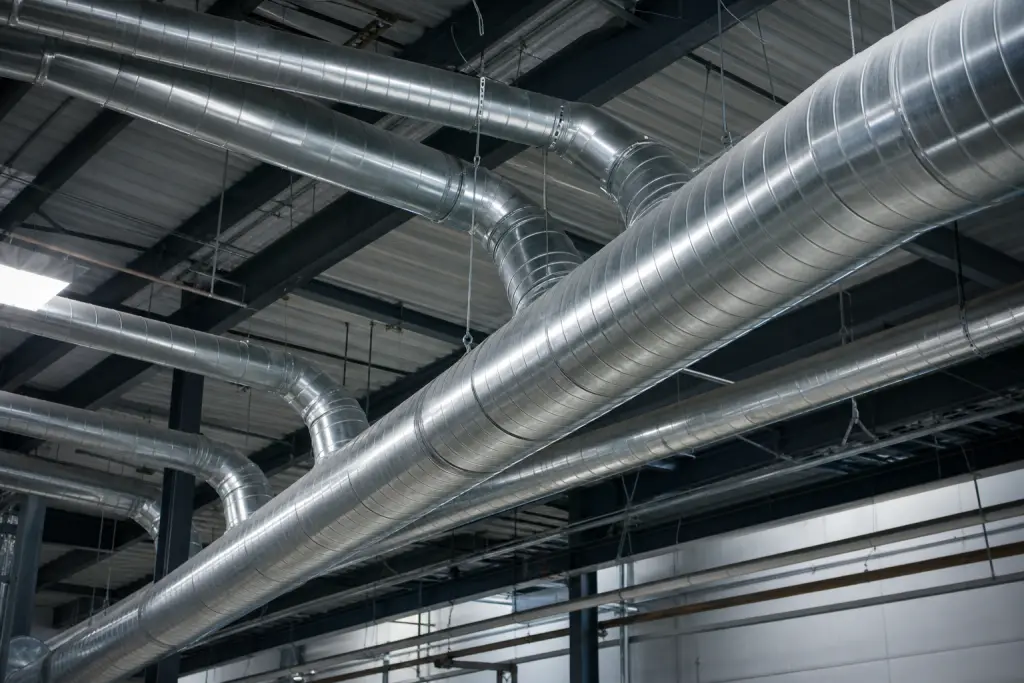
Dust collection ductwork serves a wide range of industries in the Columbus metropolitan area and throughout central Ohio. The ductwork requirements vary significantly by application:
Woodworking and millwork operations generate large volumes of chips, sawdust, and fine particulate. These systems typically require larger-diameter round ductwork with heavy-gauge construction to handle the abrasive nature of wood waste. Branch connections at each machine — table saws, planers, jointers, CNC routers — must be sized for the specific CFM requirement of that tool.
Metalworking and grinding facilities produce fine metal particulate and, in some cases, sparks. Ductwork for these applications often requires heavier gauge material, spark-resistant construction, and careful attention to grounding and bonding to prevent static discharge. Stainless steel may be specified for corrosive particulate or where contamination control is critical.
Concrete, aggregate, and masonry operations deal with highly abrasive mineral dust that accelerates wear on ductwork interior surfaces. Heavier gauge construction and wear-resistant materials extend service life and reduce replacement frequency.
Food processing and pharmaceutical facilities often require stainless steel ductwork to meet sanitation standards, with smooth interior surfaces and accessible cleanout points for washdown procedures.
In each case, the ductwork is not interchangeable. What works for a woodworking shop will not meet the requirements of a metalworking grinder line, and neither will satisfy pharmaceutical cleanroom standards.
Materials and Construction: Choosing the Right Duct for the Dust
Material selection for dust collection ductwork depends on the type of particulate, the operating environment, and applicable codes. The most common options include:
Galvanized steel is the standard for general-purpose dust collection ductwork. It offers good corrosion resistance, reasonable cost, and wide availability in standard gauges. Most woodworking, general manufacturing, and light industrial applications specify galvanized ductwork in 18- to 22-gauge, depending on diameter and system pressure.
Carbon steel is specified for heavy-duty applications where greater wall thickness is needed — high-velocity systems, abrasive materials, or larger-diameter trunk lines that require structural rigidity. Carbon steel ductwork is typically finished with a protective coating to prevent corrosion.
Stainless steel is required where corrosion resistance, sanitation, or contamination control is critical. Food processing, pharmaceutical, and chemical handling applications frequently specify 304 or 316 stainless steel ductwork. The material cost is higher, but the longevity and compliance value justify the investment.
Aluminum is used where weight is a concern or where the particulate is non-abrasive and the environment is mildly corrosive. It is less common in dust collection than in HVAC but has specific applications in food-grade and cleanroom environments.
Regardless of material, dust collection ductwork must be fabricated with tight seams and secure joints. Air leaks at duct connections reduce system efficiency and can allow dust to escape into the facility — exactly the problem the system is designed to prevent.
The Role of CNC Precision in Ductwork Fabrication
Modern dust collection ductwork fabrication depends heavily on CNC cutting and forming equipment. The precision these machines deliver is not optional — it is what separates ductwork that maintains design velocities from ductwork that leaks, creates turbulence, and underperforms.
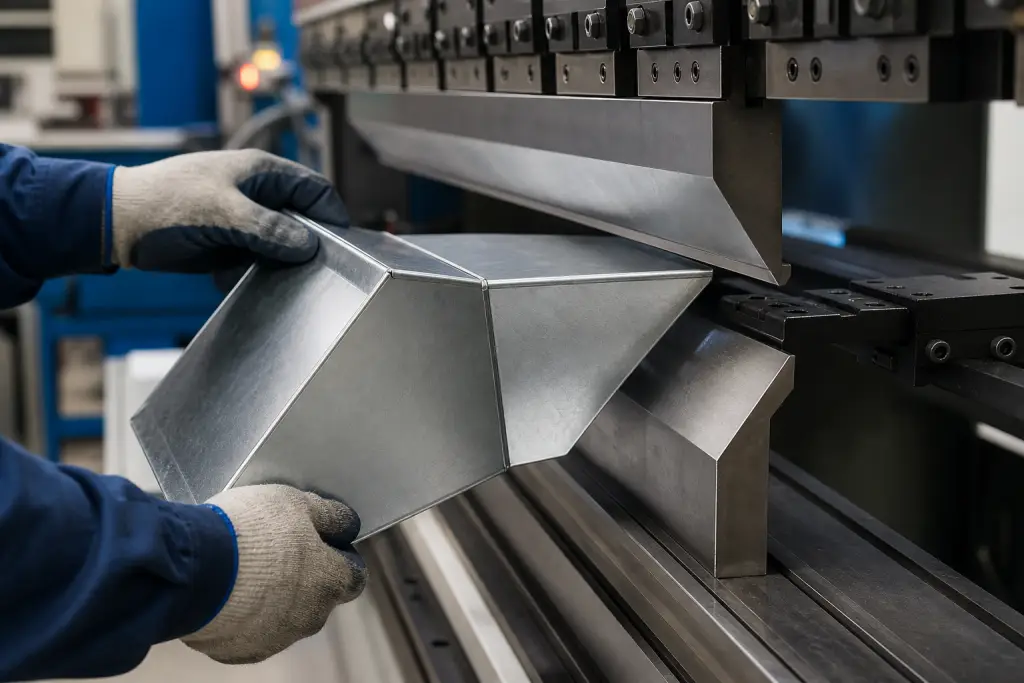
CNC plasma and laser cutting produce clean, dimensionally accurate blanks for round and rectangular duct sections, transitions, branch fittings, and custom components like hoods and collection plenums. CNC press brakes form angles and flanges to tight tolerances, ensuring components assemble without gaps.
At Sheet Metal Shop in Columbus, this precision is available in-house. Every component — from large-diameter trunk lines to small branch fittings and custom hood assemblies — is cut, formed, and assembled under one roof. There is no outsourcing to coordinate, no shipping delays on critical components, and no ambiguity about dimensional accuracy.
For facility managers and contractors working on dust collection projects, this means one point of contact for all custom ductwork, shorter lead times compared to ordering from distant fabricators, and the ability to review components locally before installation.
Compliance and Code Considerations
Dust collection systems in Ohio must comply with several layers of regulation that directly impact ductwork design and construction:
OSHA 1910.94 establishes general requirements for ventilation and dust collection in manufacturing environments. It mandates that exhaust systems include dust collecting equipment, that hoods be designed to capture particulate at the point of generation, and that ductwork be constructed to maintain effective transport velocities.
NFPA 652 and NFPA 68 address combustible dust hazards. Facilities handling wood dust, metal powders, food ingredients, pharmaceutical compounds, or other combustible particulates must ensure their ductwork and collection systems meet fire and explosion prevention standards. This includes proper grounding and bonding of all duct sections, explosion venting provisions, and spark detection or suppression in some applications.
Local building codes and fire codes in Columbus and Franklin County may impose additional requirements for duct materials, fire damper placement, and system testing.
Custom-fabricated ductwork from a local shop allows contractors and engineers to specify exactly what each code requires — material type, gauge, joint construction, grounding provisions, and cleanout access — without being limited to what is available in a standard catalog.
Why Local Fabrication Matters for Dust Collection Projects
Dust collection ductwork projects move fast once installation begins. When a system is being installed during a planned facility shutdown or a maintenance window, every day of downtime has a cost. Waiting on ductwork shipments from out-of-state fabricators introduces risk that local fabrication eliminates.
Working with a Columbus-based fabrication shop like Sheet Metal Shop provides several practical advantages:
- Faster turnaround on custom components. When field conditions reveal the need for an unplanned transition piece, offset, or hood modification, a local shop can fabricate and deliver it in days rather than weeks.
- Direct communication with fabricators. Contractors and engineers can review drawings, discuss tolerances, and inspect finished components in person — eliminating the misunderstandings that arise from remote coordination.
- Responsive to change orders. Renovation and retrofit projects inevitably involve discoveries once ductwork demolition begins. A local fabrication partner can adjust scope and schedule without the delays of long-distance logistics.
- Reduced shipping cost and damage risk. Large-diameter ductwork and custom fittings are awkward to ship. Local pickup or short-haul delivery keeps costs down and reduces the chance of transit damage.
For contractors and facility managers across the Columbus metro — including Dublin, Westerville, Grove City, Reynoldsburg, and the broader Franklin County area — having a fabrication shop within driving distance of the job site is a significant project management advantage.
Getting Started on Your Dust Collection Ductwork Project
Whether you are building a new dust collection system from scratch, expanding an existing system to cover additional equipment, or replacing deteriorated ductwork in an aging facility, the process starts with understanding what the system requires and having a fabrication partner who can deliver it.
Sheet Metal Shop in Columbus, Ohio, fabricates custom dust collection ductwork for contractors, mechanical engineers, and facility managers across central Ohio. With CNC precision cutting, full in-house production capabilities, and over 50 years of combined fabrication experience, we build the ductwork your dust collection system needs to perform — on spec, on time, and built to last.
Call Sheet Metal Shop today to discuss your dust collection ductwork requirements, or visit sheetmetalshopcolumbus.com to request a quote.