Aluminum Repair in Columbus, Ohio: When to Weld a Part Back Into Service and When to Replace It
A cracked aluminum housing, a torn duct flange, a broken bracket on production equipment. You have a machine down and two options: wait weeks for a replacement piece that may no longer be manufactured, or get the part welded back into service this week. We handle aluminum repair in Columbus, Ohio out of our Clara Street shop, and the first thing we do on any repair job is tell you honestly whether welding is the right call.
Not every broken aluminum part should be repaired. Some are not worth the labor, some cannot be welded because of the alloy, and some crack again in the same spot unless the actual design changes. This guide covers how we evaluate a problem and where repair beats replacement for central Ohio contractors, facility managers, and plant engineers.
Why Aluminum Repair Is Harder Than Steel Repair
Aluminum behaves differently under an arc, and that drives how we approach a repair.
Aluminum carries a surface oxide layer that melts near 3,700 degrees F while the base metal underneath melts around 1,200 degrees F. If that oxide is not removed and kept off the joint, it traps inclusions and the repair fails. Aluminum also moves heat roughly five times faster than steel, so thin sections and edges distort or burn through when heat input is not controlled. It gives no color change as it nears melting temperature, so there is no visual warning before the puddle drops out.
On a used part, contamination makes this worse. Molten aluminum pulls in hydrogen, and oil, grease, paint, coolant, and hydrated oxide all carry hydrogen into the weld pool, which shows up as porosity. A component that has run in a plant for ten years needs real cleaning first. That is why a five-minute weld often takes an hour of prep.
Identifying the Alloy Comes First
You cannot pick a welding procedure without knowing what the part is made of. Some alloys weld well, some weld poorly, and some react badly to a filler that works fine elsewhere. The 3000, 5000, and 6000 series wrought alloys we see most in HVAC, architectural, and equipment work are readily weldable. Most 2000 and 7000 series alloys are not, and we tell you when a part falls in that group.
Casting alloys break into families the same way. The 3XX and 5XX casting families weld readily. Roughly 80 to 90 percent of castings you will encounter are 3XX, most commonly 356. The 2XX and 7XX casting families should generally be left alone. We match filler to family: 4043 for 3XX castings, 5356 for 5XX. When a casting’s alloy is genuinely unknown, 4043 is the sensible default because of how heavily 3XX dominates the population.
The casting process matters as much as the chemistry. Sand and permanent mold castings cool slowly, dissolved gas escapes, and they weld about like wrought material. Die castings are the problem. They are injected fast, they trap die lubricant and gas, and any weld breaking through the surface skin turns extremely porous. If your part is a die casting, we say so up front rather than taking your money for a repair that won’t hold up.
If you know the original manufacturer, tell us. That is the fastest path to a confirmed alloy. Without a reliable source, lab chemical analysis is the only way to know for certain, and for many parts that cost pushes the decision toward fabricating a new one.
Aluminum Repair or Replace: How We Make the Call
The economics are simple: compare repair labor against the delivered cost of a replacement.
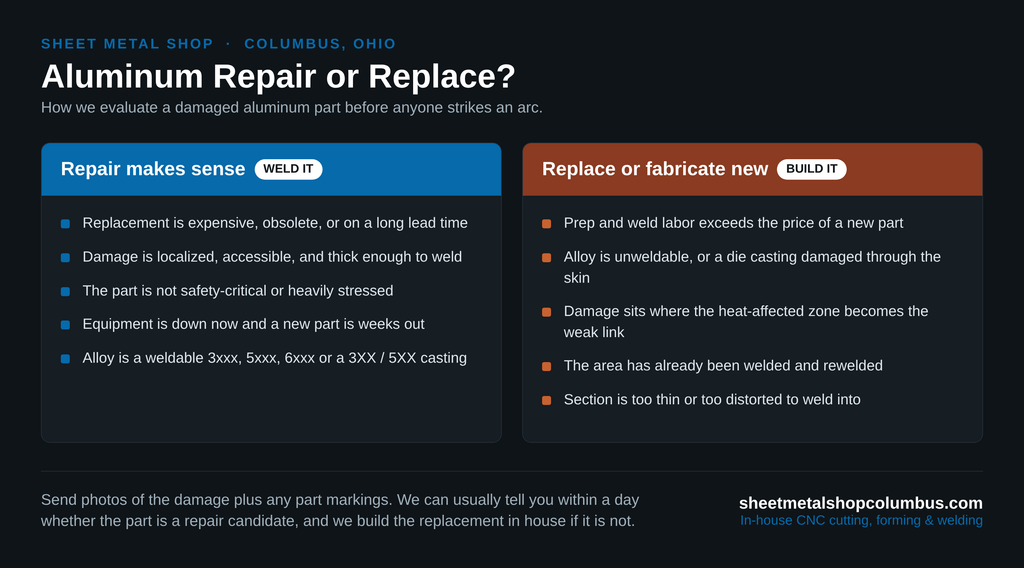
Repair makes sense when:
- The replacement part is expensive, obsolete, or on a long lead time
- The damage is localized, accessible, and in a section thick enough to weld
- The part is not carrying a safety-critical or heavily stressed load
- Equipment is down now and a new part is weeks out
Replacement or new fabrication makes more sense when:
- Labor to clean, prep, weld, and finish exceeds the price of a new part
- The alloy is unweldable, or it is a die casting damaged through the skin
- Damage sits at a critical structural point where the heat-affected zone becomes the weak link
- The part has been welded and rewelded already
- The section is too thin or too distorted to weld into
When a repair does not pencil out, we can build the replacement here from your old part, a drawing, or a DXF file. Same building, same quote, no handoff to a third party.
We also look at why the part failed. Welding over a crack without addressing the cause buys you a few months. The real fix is often a gusset, a longer weld, a different joint, or a damaged section replaced in heavier gauge.
TIG or MIG
Process selection follows thickness, access, and how fast you need the part back. TIG is the right choice below about 1/8 inch, where low heat input keeps you from burning through or warping the part. TIG also wins on cast aluminum and tight access, because the torch reaches into a constricted area. The tradeoff is speed. MIG moves faster on thicker material and larger repairs, with less spatter and good control once the procedure is set. When a plant needs the part back on a shift schedule, that speed decides it.
We run both aluminum welding processes in house, so the process fits your part instead of fitting whatever equipment is available.
Aluminum Repair, Columbus Ohio: What We See Most
Across HVAC, industrial, and commercial work in central Ohio, aluminum repair requests cluster into a handful of categories.
HVAC and ductwork components. Cracked plenum seams, damaged transitions, torn flanges, bent curb adapter sections. When damage is bad enough, we form a new section on the press brake and tie it into the existing run.
Equipment guards, housings, and enclosures. Forklift strikes and vibration crack brackets and mounting feet on production equipment. These are strong repair candidates because OEM replacements carry long lead times.
Food service parts. Aluminum tables, hoods, shelving, and equipment panels take damage in daily service. Repair keeps a kitchen running when a new unit is weeks out.
Architectural and building components. Aluminum trim, fascia, panels, and louvers get damaged during construction projects and renovations. Matching an existing profile matters more than raw strength, so forming a replacement piece is often cleaner than welding the damaged one.
Industrial commercial weldments and structural supports. Cracked frames, racks, platforms, and skids. AWS D1.2, the Structural Welding Code for Aluminum, governs welded aluminum structures. The 2026 edition is the first update since 2014 and adds a dedicated clause on strengthening and repair of existing structures. D1.2 has no prequalified procedure path, so every welding procedure has to be qualified by testing.
One thing we do not do: cosmetic aluminum wheels. Curb rash, wheel straightening, and aluminum polishing belong at a wheel specialist. We are an aluminum fabrication and repair shop serving industrial and commercial customers.
What to Send Us for a Fast Aluminum Repair Quote
The more you send, the faster you get a real number instead of a guess.
- Photos. Several angles of the damage plus one of the whole part, with any stamped part numbers or alloy markings.
- Material and thickness. Alloy if you know it, the OEM if you do not. Approximate wall thickness helps us pick the process.
- Cast or wrought. For a casting, tell us sand, permanent mold, or die cast when you know.
- What the part does. Load-bearing, pressure-containing, cosmetic, or a guard. This drives whether a repair is acceptable at all.
- Timeline. Down machine today or planned shutdown next month.
- History. Previous repairs in the same area change the approach.
Photos alone let us tell you within a day whether the part is a repair candidate or not.
Why In-House Fabrication Changes Your Options
We have run custom metal fabrication out of Columbus for over 50 years, with everything under one roof: CNC plasma cutting, forming, welding, and finishing. Whether the outcome is a weld repair, a section replacement, or a new fabricated part, it stays with us. A shop that only welds has one answer to every problem, while our recommendation is not tied to selling you a repair.
Frequently Asked Questions
Can you weld cast aluminum?
Usually yes. Most castings are 3XX family alloys that weld readily with 4043 filler. The exceptions are 2XX and 7XX casting alloys, which we avoid, and die castings, where welding through the surface skin creates heavy porosity. Send photos and any part markings, and we can place yours in the right category.
What if I do not know what alloy the part is?
Tell us the original manufacturer and we can usually work it out. If the alloy cannot be confirmed from a reliable source, lab chemical analysis is the only certain method, and for most parts that cost makes fabricating a new one the better path.
How long does an aluminum repair take?
It depends on cleaning, access, and whether we need to form a replacement section. We give you a realistic window with the quote and confirm the date when you approve it. Our in-house capacity means we are not waiting on another shop’s queue.
Is a repaired weld as strong as the original part?
The heat-affected zone around any aluminum weld loses some strength against the parent material. For guards, brackets, housings, and ductwork that is fine. For heavily stressed structural connections we usually recommend reinforcing the design or fabricating new instead.
Can you fabricate a new part if the repair does not make sense?
Yes, and that is a common outcome. Bring us the broken part, a drawing, or a DXF file and we will build a replacement. Reverse engineering from a sample is routine work here.
Get an Answer on Your Part This Week
Send photos of the damage and we will tell you whether welding makes sense or whether a new part saves you money and holds up longer. Fast, accurate answers keep your equipment safe and your schedule intact.
Call the shop or request a quote at sheetmetalshopcolumbus.com to get your aluminum repair scoped.