Welded Steel Ductwork in Columbus, Ohio: When Standard Duct Isn’t Enough
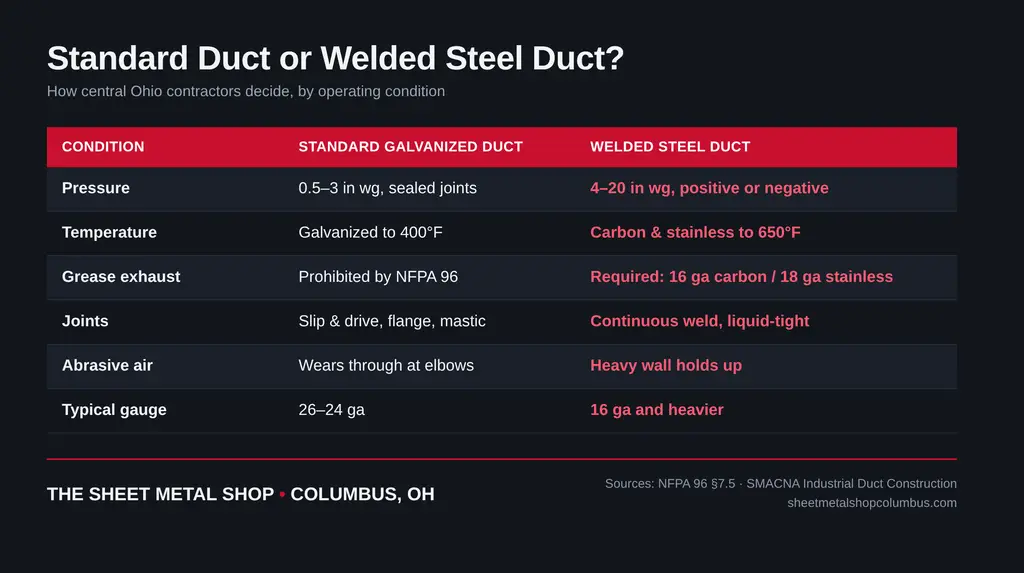
Most commercial HVAC ductwork in central Ohio is snap-lock and slip-and-drive galvanized. It is sealed with mastic and built to a 1 or 2 inch water gauge pressure class. That construction works fine for conditioned supply and return air, but it falls apart the moment you push grease, high static pressure, corrosive fumes, or 600 degree exhaust through it.
Welded steel ductwork that contractors specify is what you need to use when the system has to hold pressure, resist abrasion, or pass a fire inspection. We fabricate it in house at our Columbus sheet metal shop. This is the guidance we give contractors and engineers before they send a print.

What Makes Welded Steel Ductwork Different From Standard Duct
Standard HVAC ductwork is joined mechanically. Seams are folded and locked, transverse joints use slips and drives or a flanged system, and the sealant makes them airtight. That approach relies on the sealant staying flexible throughout the lifetime of the system.
Welded duct is joined with a continuous weld, meaning there is no folded seam to leak through, no sealant to fail, and no gasket to degrade. The wall in welded duct is also thicker than standard ductwork. Where a standard 24 by 12 low pressure duct runs 26 or 24 gauge, welded duct usually starts at 16 gauge and goes heavier from there.
Commercial HVAC duct work and welded process duct are two different products from the same sheet metal shop. There are four key differences between the two:
- Pressure. SMACNA recognizes seven pressure classes, from half an inch water gauge up to 10 inches. Above 4 inches you need Seal Class A, which means every transverse joint, longitudinal seam, and wall penetration gets sealed. At the top of that range, welding is more reliable than sealant.
- Temperature. SMACNA’s industrial duct guidance covers carbon and stainless steel to 650 degrees F, galvanized to 400 degrees, and aluminum to 120 degrees. Hot exhaust rules out galvanized quickly.
- Abrasion. Dust, chips, and grit sandblast the inside of a duct from the inside out. Thin wall duct wears through at every elbow.
- Code. Some systems are required by code to be welded. Grease exhaust is the clearest example.
Grease Duct: Where Code Decides for You
If you are building kitchen exhaust in Ohio, NFPA 96 removes the choice. The standard requires grease duct built from carbon steel at least 0.060 inch thick, which is 16 gauge, or stainless steel at least 0.048 inch, which is 18 gauge. Every seam, joint, penetration, and duct-to-hood collar connection needs a liquid-tight continuous external weld.
NFPA 96 also bans aluminum, galvanized steel, and fiberglass reinforced plastic in grease duct entirely. Field joints must be overlapping telescoping or bell type, with the inside section uphill of the outside section. Butt welded joints are not permitted.
Our metal fabrication crew builds to those requirements as a matter of course. A grease duct failing inspection would mean that the restaurant gets shut down. If you are pricing a hood package for a Columbus buildout, the duct work is the wrong line item to value engineer.
Where Welded Steel Ductwork Shows Up in Central Ohio
Beyond grease exhaust systems, welded steel ductwork shows up anywhere the air is dirty, hot, or moving hard. Across central Ohio that means:
- Paint booth and finishing exhaust, where solvent vapor and overspray attack the seams and sealant on standard duct.
- Foundry, forge, and heat treat exhaust, where duct temperature sits well above what galvanized can handle.
- Chip and grinding collection in machine shops, where metal fines chew through thin wall duct at every turn.
- Boiler breeching and combustion air, where the duct is part of a pressurized appliance system.
- Fume and vapor exhaust in labs, plating shops, and chemical processing, where 304 or 316 stainless is the only material that survives.
- Structural steel supports and hangers for heavy duct runs, which we fabricate alongside the duct so the whole assembly ships together.
SMACNA’s industrial duct standards cover round duct from 4 to 60 inches and rectangular duct built from panels up to 16 feet wide. Both are rated for 4 to 20 inches water gauge, positive or negative. Those are the numbers your engineer works from, and the numbers we build to.
Material Selection: Carbon, Galvanized, or Stainless
Three materials cover almost every welded duct job we run.
Carbon steel is the default for industrial exhaust and grease duct fabrication. It welds cleanly, costs the least per pound, takes high heat, and resists abrasion. Bare carbon steel rusts, so exterior runs and wet service get primed and painted or coated.
Galvanized steel can be welded, but the zinc coating burns off in the weld zone and puts off fumes that require real ventilation. The burned areas then need cold galvanizing compound to restore corrosion resistance. For welded systems we usually recommend carbon steel and a coating instead.
Stainless steel is the answer for corrosive fumes, washdown environments, food and pharma process air, and any grease duct where the owner wants the longer service life. Type 304 handles most of it. Type 316 adds the chloride resistance you need around pools, plating, and coastal or chemical exposure.
We stock and cut all three, so material choice does not add any time to your schedule. Our custom fabrication and welded steel duct work all runs through the same shop floor.
How We Build Welded Steel Ductwork in House
Every welded duct job at our Columbus shop runs the same path.
- Print or field measurement. Send a DXF, DWG, or PDF with dimensions, or send us field dimensions from the site. For retrofits, we would rather have your measurements of what is actually there than a drawing of what was supposed to be there.
- Nesting and CNC plasma cutting. Panels, transitions, elbow gores, and flange plates get nested on our plasma table so we cut the whole assembly from as little material as possible.
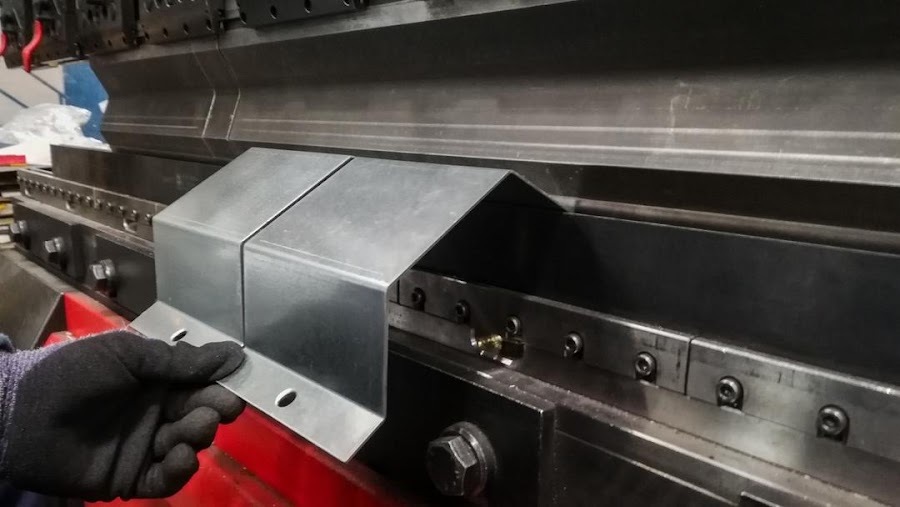
- Forming. Press brake work on panels, rolling on round sections, and flanging where the connection calls for it.
- Fit up and welding. Continuous weld on seams and joints, spot or stitch weld only where the spec allows it.
- Cleanup and finish. Grinding, deburring, and prime or coating when the job calls for it.
- Delivery. We deliver across the Columbus metro and the greater central Ohio region. Pieces are tagged to match your installation drawings, so your crew is not sorting parts in a mechanical room.
Everything happens under our roof. Nothing ships to a second shop for cutting or welding. That is the main reason our lead times on welded steel ductwork in Columbus, Ohio beat what most contractors expect. If your job also needs flat parts or brackets, our CNC plasma cutting runs on the same table.

What to Send Us for an Accurate Quote
The quotes that come back fastest include all of this in the original request:
- Duct sizes and total footage, with a sketch or drawing if you have one
- Material and gauge, or the operating conditions so we can specify it
- Pressure class and any leakage requirement
- Operating temperature and what is moving through the duct
- Fitting count: elbows, transitions, taps, tees, access doors
- Connection type: flanged, companion angle, or welded in the field
- Whether the system falls under NFPA 96 or another code
- Finish requirements and your install date
If some of that is unknown, send what you have. We would rather ask two questions up front than build the wrong thing fast.
Frequently Asked Questions
u003cstrongu003eHow much more does welded duct cost than standard galvanized duct work?u003c/strongu003e
Expect a meaningful premium, driven by heavier material and the labor hours in continuous weld. The gap narrows on complex systems, where welded construction cuts field sealing labor and rework. We quote every job from the actual print, so ask us for a real number rather than working from a rule of thumb.
u003cstrongu003eCan you weld galvanized duct?u003c/strongu003e
Yes, with proper ventilation and cold galvanizing on the weld zone afterward. For most welded systems we recommend carbon steel with a coating instead, because you get a better weld and a more predictable finish.
u003cstrongu003eWhat is your lead time on welded duct?u003c/strongu003e
It depends on footage, fitting count, and material availability. Straightforward duct fabrication moves in days rather than weeks, because we cut, form, and weld in the same building instead of buying from ductwork suppliers. Call us with your install date and we will tell you honestly whether we can hit it.
u003cstrongu003eDo you fabricate stainless grease duct to NFPA 96?u003c/strongu003e
Yes. We build grease duct in 16 gauge carbon steel and 18 gauge stainless with liquid-tight continuous external welds, telescoping field joints, and the slope your inspector expects.
u003cstrongu003eCan you match an existing duct system that has no drawings?u003c/strongu003e
Yes. Send field measurements and photos of the existing connections. We fabricate custom ductwork sections and transitions to match what is already installed.
u003cstrongu003eDo you deliver outside Columbus?u003c/strongu003e
We deliver custom ductwork and fabricated parts throughout the Columbus metro and the greater central Ohio region, including Dublin, Westerville, Grove City, Newark, Delaware, and Lancaster.
Get a Quote on Welded Steel Ductwork, Columbus Ohio
Send your print or your field dimensions and you will get back a firm price with a real lead time. Our CNC plasma table, press brakes, and welders sit in one Columbus building. You get faster turnaround, tighter fit up, and duct that lands on site ready to hang, which saves your crew field hours and keeps the install date safe.
Call us or get a quote through sheetmetalshopcolumbus.com and we will price your duct fabrication package this week.