
AC Unit Cage Guide: Protecting Rooftop and Ground Units From Copper Theft
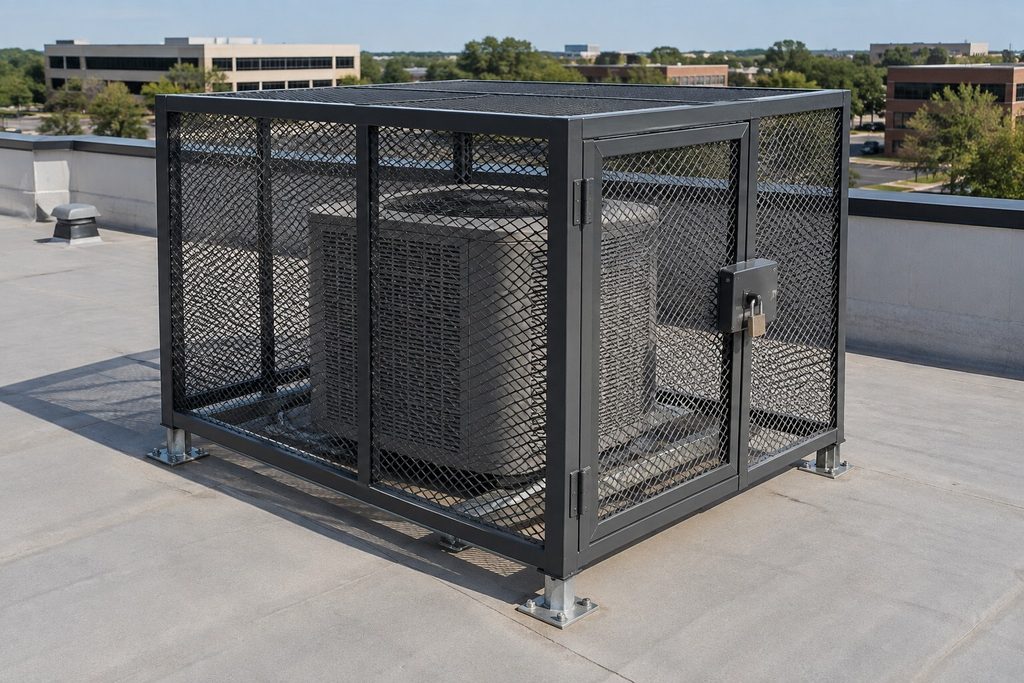
An AC unit cage is a welded metal enclosure that bolts down around a condenser or rooftop unit (RTU) so thieves cannot reach the copper inside. If you manage a strip center, school, church, or warehouse in Columbus, one stripped unit can mean a new coil, a refrigerant recharge, and days without cooling. A well-built cage makes that theft much harder.
This guide is for facility managers. It covers why units get targeted, what a fabricated cage needs, and when a custom cage makes more sense than using a stock one. We build these cages in our shop on Clara Street, so we also list what to measure before you call us.
Why Thieves Target Condensers and Rooftop Units
Many outdoor units carry copper in two places: the tubing inside the condenser coil and the refrigerant line set that runs back to the building. Both sit outside, often out of view of staff and cameras. Facilities Dive reported in July 2025 that thefts of copper from HVAC systems and buildings climbed as copper prices hit record highs.
The scrap value of the copper is small next to your repair bill. When a line set is cut, the refrigerant fluid vents and leaks, and the contractor has to replace the tubing, pull a vacuum, and recharge the whole system. If the coil is gone, the unit may be a total loss. Vacant buildings, rear lots, and flat roofs with easy ladder access are especially vulnerable, because nobody is watching them.
A security cage does not make a unit impossible to steal from. But it does add time, noise, and tools to the job, which raises the odds that someone notices and the theft will be unsuccessful.
What a Fabricated AC Unit Cage Needs
A cage that only blocks thieves is easy to build. A cage that also lets the unit breathe and lets your HVAC tech work is more difficult. Every outdoor ac unit cage we build has to cover the four items below.
| Design item | What to specify | Why it matters |
|---|---|---|
| Service access doors | Hinged or removable panels on the sides the tech uses | The unit still needs filter, coil, and electrical service |
| Airflow clearance | The unit maker’s minimum clearances on every coil face and above the fan | A tight cage traps hot discharge air and cuts capacity |
| Anchoring | Concrete anchors on a pad, or fasteners into the curb, rails, or structural steel on a roof | A cage that lifts off protects nothing |
| Locks | Lock boxes that shield the padlock, plus tamper-resistant fasteners | Exposed padlocks and standard screws are easy to defeat |
Service access doors. Ask your HVAC contractor which panels they open on a normal service call, then put doors there. A door that swings clear of the panel saves your tech from pulling the whole cage.
Airflow clearance. Check the installation manual for your unit. It will have the minimum clearance on each coil face and above the fan discharge listed out. Many condensers discharge air straight up through a top fan, so the top of the cage needs to have an open grid, and the panels should use an open mesh such as expanded metal.
Anchoring. On a ground pad, we anchor the frame into the concrete. On a roof, anchor points need to tie into the unit’s curb, equipment rails, or structural steel. Talk to your roofer before anyone drills through the membrane.
Locks. A padlock hanging in the open is easy to cut. A welded lock box shrouds the shackle so cutters cannot get a grip, and security fasteners keep someone from unbolting the panels.
Keep the Unit Serviceable and Code Compliant
A cage cannot block what the code requires to stay reachable. The National Electrical Code (NEC) section 440.14 requires the disconnect for air conditioning equipment to be within sight of the unit and readily accessible. The disconnect also has to keep the working space set by NEC 110.26(A), which is at least 30 inches wide in front of the equipment. If the disconnect sits inside the cage footprint, give it its own locking door, or ask your electrician about relocating it outside the cage.
Rooftop units near a roof edge raise a second issue. The International Mechanical Code section 304.11 requires guards where equipment that needs service sits within 10 feet of a roof edge that drops more than 30 inches. Those guards must be at least 42 inches high. A cage around the unit does not replace that guard, so plan both together.
Keep these points in mind at the design stage:
- Leave room for the line set, condensate line, and power whip to enter the cage.
- Keep the nameplate readable through the mesh or through an access door.
- Size doors so a tech can reach the service valves and the control panel.
- Give a copy of the key or combination to your HVAC service company.
Custom vs Off-the-Shelf Cages
Stock cages come in set sizes built around common residential condensers. They can work if your unit matches one of those sizes and sits on a clean, level pad. A window ac unit cage is a separate product for window units, and it does not apply to the pad and rooftop equipment covered here.
Many commercial sites do not fit standard catalog sizing. RTUs sit on curbs with ductwork below, several condensers often share one pad, and older equipment comes in sizes a stock cage simply does not match. A cage for ac unit layouts like these has to be measured and built to the specific site.
A custom ac unit metal cage lets you:
- fit one enclosure around a row of condensers
- place doors where your tech actually works
- match the anchoring to a pad, curb, or roof rail
- choose the material for the location
Your ac unit cage cost depends on unit size, number of units, material, and the number of doors and locks. We quote each job from your specific measurements, so you pay for exactly the cage your site needs and nothing extra.
How We Build an AC Unit Protective Cage in Columbus
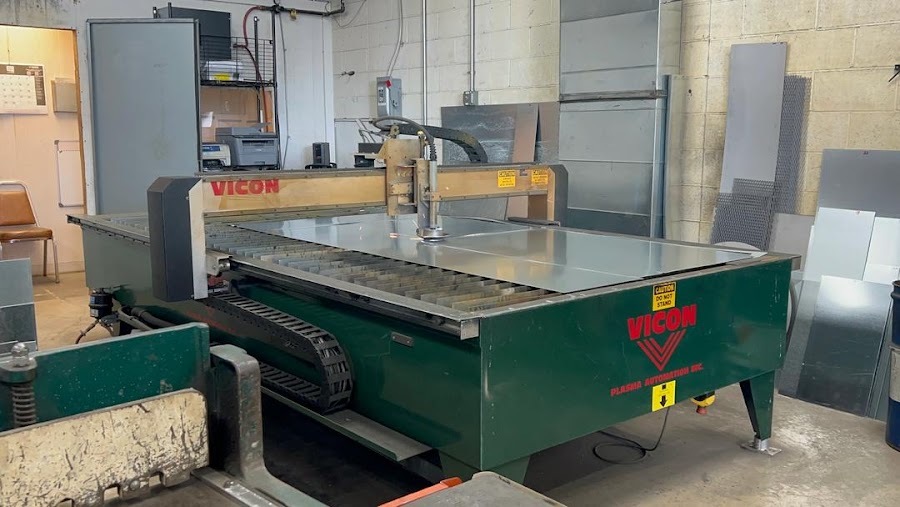
We build every ac unit protective cage in-house at our Columbus shop. We cut parts on our CNC plasma table, form them on our press brake, and weld frames from angle iron. Panels can be steel, stainless steel, or aluminum, depending on where the unit sits and how long you need the cage to last.

Before you request a quote, measure and photograph:
- unit length, width, and height, plus the model number from the nameplate
- pad or curb size, and the distance to walls, other units, and the roof edge
- where the line set, condensate line, and electrical enter the unit
- the location of the disconnect
- which panels your HVAC tech opens for service
- ground or roof, and how we can reach the site
Photos from two sides and one from above help us catch problems before we cut steel. If you already have a cage idea sketched, send that too. Our post on HVAC curb adapters covers the rooftop measuring process in more detail.
Security Cage FAQ
Does a cage hurt airflow?
It can if the cage is too tight or uses solid panels. Follow the unit maker’s clearance numbers and use open mesh on the coil faces and top.
Can my HVAC tech still service the unit?
Yes, when the cage has access doors on the service side. Give your service company a key or the lock combination.
How is a rooftop cage anchored?
We fasten it to the unit’s curb, equipment rails, or structural steel. Your roofer should approve any fastener that goes through the roof membrane.
Can one cage cover several condensers?
Yes. A custom cage can enclose a row of units on one pad, with doors placed for each unit’s service panels.
What material should I choose for an outdoor unit cage?
Steel keeps material cost down. Stainless steel and aluminum hold up better against corrosion. We can help you pick based on your site.
Protect Your Equipment Before the Next Break-In
A cage built to your unit keeps thieves out, keeps air moving, and keeps your service calls short. That saves your budget from coil replacements and protects your tenants from days without cooling. We are an R-Stamp certified shop at 1588 Clara Street, and we build anti-theft security cages for facility teams and contractors across central Ohio.
Call (614) 989-6835 or request a quote and send us your measurements and photos. We will build an AC unit cage that fits your equipment.