
The 304 vs 316 stainless question comes up whenever you order a custom stainless steel part, and the right choice depends on what the part will touch once it’s installed. If you manage a facility in central Ohio and you’re replacing a hood panel, a washdown enclosure, or an outdoor guard, the grade on your drawing will affect how long that part is going to last and what it will cost.
This guide is for facility managers. It compares the composition, mechanical properties, corrosion resistance, weldability, and cost of the two grades, then shows you how to specify and verify what you ordered. For a broader look at choosing between metals, see our post on galvanized vs stainless vs aluminum.
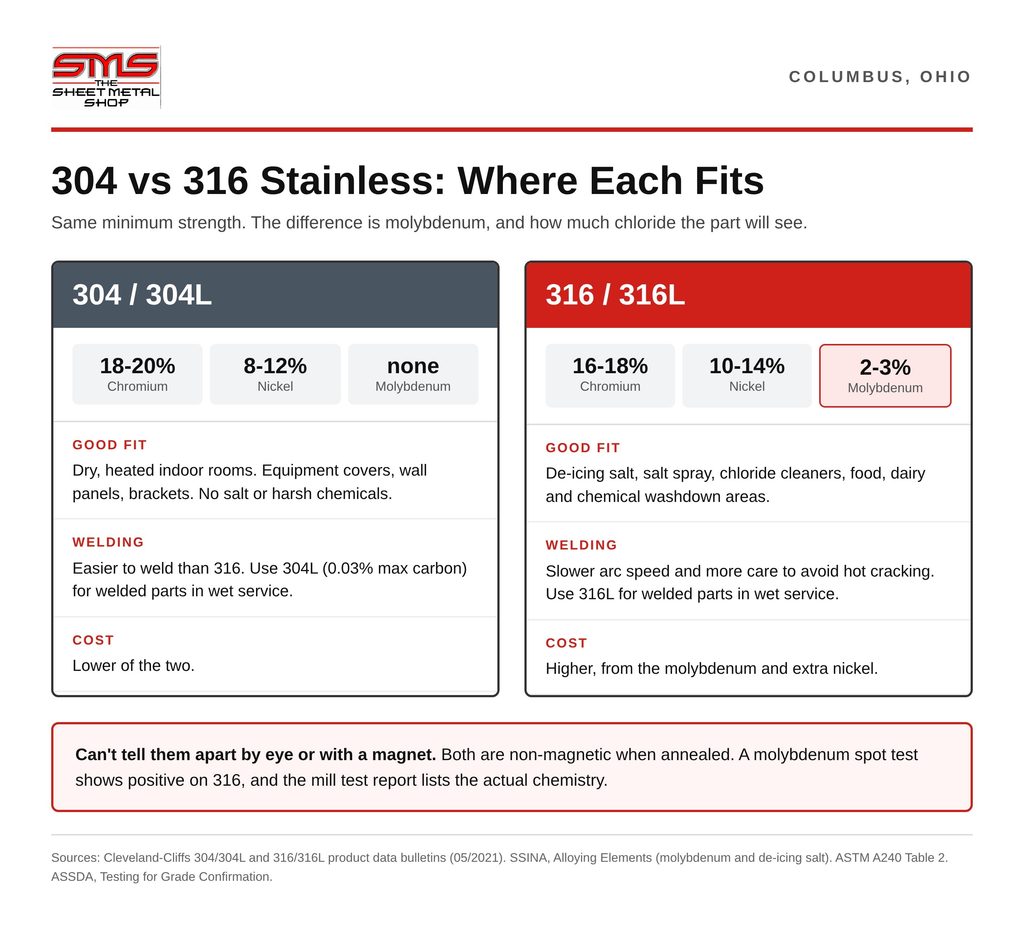
Composition: What Makes 316 Different From 304
Both grades are austenitic stainless steels, which means they’re chromium and nickel alloys that aren’t attracted to a magnet in the annealed condition. The main difference between them is one added element.
Cleveland-Cliffs publishes these composition ranges in its product data bulletins for the two grades:
| Type | Chromium | Nickel | Molybdenum | Carbon (max) |
|---|---|---|---|---|
| 304 | 18 to 20% | 8 to 12% | none listed | 0.08% |
| 304L | 18 to 20% | 8 to 12% | none listed | 0.03% |
| 316 | 16 to 18% | 10 to 14% | 2 to 3% | 0.08% |
| 316L | 16 to 18% | 10 to 14% | 2 to 3% | 0.03% |
Type 316 has slightly less chromium than 304, more nickel, and 2 to 3% molybdenum (Mo). The “L” versions have the same alloy content with a lower carbon limit, which matters for welded parts.
The mechanical properties are close. ASTM A240, the standard for stainless sheet and plate, lists the same minimum tensile strength (75 ksi) and yield strength (30 ksi) for annealed 304 and 316. Cleveland-Cliffs notes that 304L has slightly lower mechanical properties than 304. That means strength usually isn’t the reason to pick one grade over the other, but corrosion is.
Corrosion Resistance in Food, Chemical and Outdoor Settings
According to Cleveland-Cliffs, 316 and 316L have better chloride corrosion resistance than 304 because of the added Mo. The Specialty Steel Industry of North America (SSINA) says 316 with 2% Mo is preferred over 304 in coastal and de-icing salt situations. Cleveland-Cliffs also lists parts exposed to marine atmospheres among the typical uses for 316.
Ohio isn’t coastal, but de-icing salt is part of every winter here. Here’s how the grades line up by environment:
- Dry indoor spaces. Equipment covers, wall panels, and brackets in heated, dry rooms are usually fine in 304.
- Food and dairy areas. Cleveland-Cliffs lists good chemical resistance for 316 to most agents used in the food and dairy industries. If a part sees regular washdown with chloride cleaners or salt, that’s the chloride exposure 316 is designed for.
- Chemical exposure. The same data sheet rates 316 as useful in sulfuric acid environments up to 150°F when concentrations are below 5%. Check your actual chemicals and temperatures before you choose.
- Outdoor parts near salted surfaces. Railings, guards, and enclosures at loading docks, entrances, and parking areas take on salt spray all winter. SSINA’s guidance points to 316 for de-icing salt exposure.
Stainless resists corrosion well, but it can still pit in the wrong environment. Matching the alloy to the chlorides it will see is the main goal of this material selection.
Weldability and the L Grades
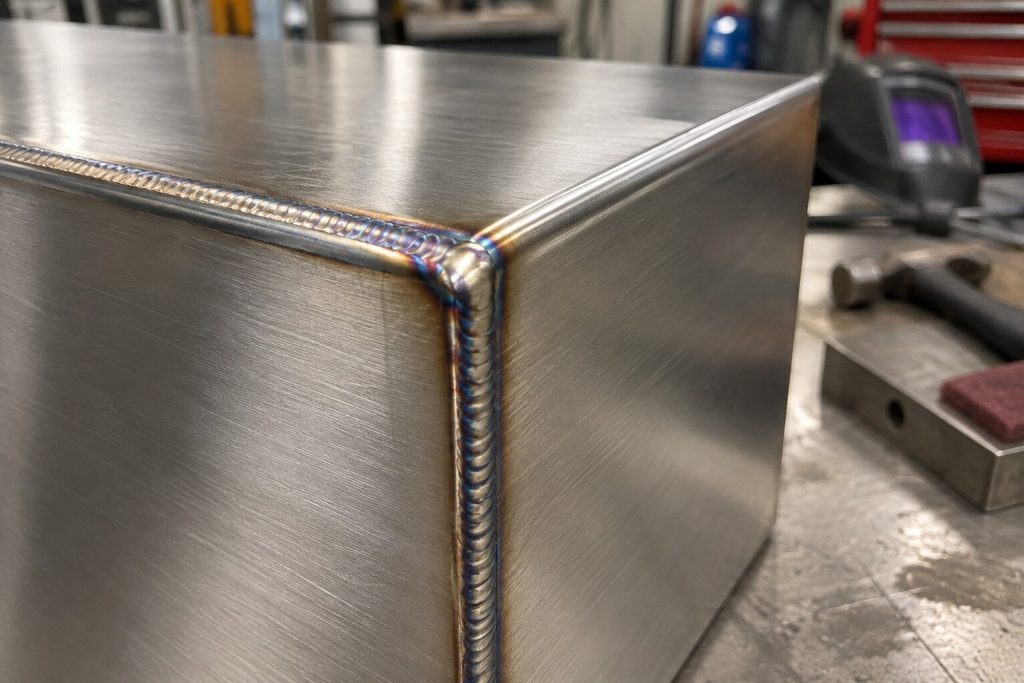
Both weld well with common fusion methods. Cleveland-Cliffs does say 316 and 316L are generally considered to have poorer weldability than 304 and 304L. The higher nickel content in 316 requires a slower arc welding speed and more care to avoid hot cracking. That extra care adds some shop time to welded 316 parts.
The L grades solve a different problem. When standard-carbon stainless is welded, chromium carbides can form near the weld. That leaves the zone around the weld more likely to corrode. Cleveland-Cliffs describes 304L and 316L, with their 0.03% carbon limit, as grades that eliminate carbide precipitation due to welding, so they can be used in the as-welded condition.
When your part is welded and then goes into a wet or chemical environment, specify 304L or 316L. If it’s a formed part with no welds in a dry room, standard 304 or 316 works.
Forming is similar for both grades. Because of its higher nickel content, 316 work hardens at a lower rate than 304, according to Cleveland-Cliffs. The same bulletin says 316 can be readily roll formed and bent in the annealed condition.
304 vs 316 Stainless: Cost and a Quick Selection Guide
316 costs more than 304 because of the Mo and the extra nickel. Prices for both change along with the nickel and Mo markets, so ask for a current quote in both if you’re on the fence.
Use this as a starting point:
Choose 304 or 304L when:
- The part lives indoors in a dry, heated space
- It won’t see salt, chlorides, or harsh chemicals
- Budget matters and the environment is mild
Choose 316 or 316L when:
- The part sees de-icing salt, salt spray, or chloride cleaners
- It’s in a food, dairy, or chemical area with regular washdown
- Replacing a corroded part costs more in downtime than the upgrade costs
When a 304 part in your building has already pitted or rusted at the welds, that history is useful information. Bring the old part or a photo, and we can talk through whether 316 or an L version fits the replacement.
How to Specify and Verify What You Ordered
Write the full alloy type on the drawing or purchase order: 304, 304L, 316, or 316L. Add the gauge, the finish, and whether the part will be welded. “Stainless” alone leaves the choice up to someone else.
Checking the alloy takes more than just a look. The Australian Stainless Steel Development Association notes that appearance isn’t a reliable indicator, and that 300 series stainless isn’t attracted to a magnet. A magnet can tell you a part isn’t 400 series, but it can’t tell 304 from 316. A molybdenum spot test shows positive on 316, and a mill test report from the supplier lists the actual chemistry of the heat. If the grade is critical, ask your fabricator to keep the mill test report on file.
We fabricate stainless parts in our own shop at 1588 Clara Street in Columbus. We cut on our CNC plasma table, form on our press brake, and weld in-house, so your part doesn’t leave our shop between steps. See our stainless steel and aluminum fabrication page for more on that work, or read our custom stainless steel fabrication guide for common stainless applications.
Frequently Asked Questions
Is 316 stronger than 304?
No. ASTM A240 lists the same minimum tensile and yield strength for annealed 304 and 316. The difference is corrosion resistance, mainly against chlorides.
Can I tell 304 from 316 with a magnet?
No. Both are 300 series austenitic grades, and neither is attracted to a magnet in the annealed condition. A Mo spot test or a mill test report can confirm 316.
Which materials can you work with, stainless steel, aluminum, or black iron?
We work with stainless steel, aluminum, carbon steel, and black iron. Each material suits different jobs. Black iron is common in exhaust ductwork, while stainless holds up well in kitchen and grease duct applications. If you’re not sure which material fits your project, we can walk you through the options.
Do you do aluminum welding and aluminum repair, not just steel?
Yes, aluminum welding and aluminum repair are among our specialties. Aluminum requires a different approach than steel, and our team is set up to handle that work. When you have an aluminum part that’s cracked, worn, or needs a custom weld, bring it in and we’ll tell you what we recommend.
Do you work with aluminum sheet for specialty or decorative projects, not just HVAC?
Yes. We fabricate aluminum sheet metal for structural, industrial, and custom decorative applications. If you have a decorative or one-off aluminum project in mind, describe it and we can tell you what’s possible with our equipment and process.
Get Your Stainless Parts Built to Spec
The right alloy on the drawing saves your maintenance team hours of rework and protects your install date. We’re an R-Stamp certified shop building stainless, aluminum, and carbon steel parts for facilities and contractors across central Ohio, and we can help you compare 304 vs 316 stainless for your next part.
Call (614) 989-6835 or request a quote and send us your drawings.