A sheet metal fabrication quote is only as accurate as the information behind it. When you send a fabricator a clear package on the first email, you get a firm number and a build date sooner, and you avoid the back-and-forth that eats a week of your schedule.
This checklist is for HVAC contractors, general contractors and facility teams in Columbus and central Ohio. It covers what to send, what to leave out, and how we turn your request into a quote at our shop on Clara Street.
Why Your Sheet Metal Fabrication Quote Stalls
A quote request often stalls due to missing details. If your request says “need a curb adapter, can you price it,” the fabricator has to come back with questions before anyone can even look at a material list. Each round of questions is going to add a day or two.
These are the gaps we see most often:
- Dimensions without a note saying whether they’re inside or outside sizes
- A material family (“stainless”) without a grade or thickness
- No quantity, or “a few”
- No date the parts are needed on site
- A photo with no measurements on it
Fabrication quotes depend on labor and material, and a shop can’t price either one until all of the information has been gathered. Provide everything up front and your sheet metal fabrication quote moves straight to the pricing phase.
The 7 Things to Send With Every Request
Our custom sheet metal fabrication page asks for drawings or sketches, dimensions, material, quantity and the date you need the job. Here’s the full list we’d send if we were on your side of the job.
- Drawings or a sketch. A PDF drawing, a CAD file, or a hand sketch with numbers on it. A sketch is enough for many parts.
- Dimensions. Mark every critical size. Say whether each one is an inside or outside dimension, and which edges have to line up with something in the field.
- Material and thickness. Galvanized, stainless, aluminum or carbon steel, plus the gauge or thickness. If the drawing calls out a specific stainless grade, include it.
- Quantity. One part, ten parts, or a full run. Setup time is spread across the quantity, so the count changes the price per piece.
- Finish. Mill finish, a brushed stainless face, a painted or powder coated part, or a note that it’ll be covered by insulation.
- Delivery or pickup. Tell us where the parts are going and how you plan to get them there.
- Your deadline. The date parts need to be on site, and whether that date is firm or flexible.
If you can, add the project name, the equipment model numbers involved, and a contact who can answer questions about fit. The same list works for HVAC fittings, guards, brackets and any other custom metal fabrication job.

Gauge, Material and Drawings: Getting the Details Right
Thickness is where we see the most confusion. A gauge number doesn’t mean the same thickness in every metal. Under the gauge tables most shops use, 16 gauge is about 0.060 inches in plain steel, about 0.064 inches in galvanized, and about 0.051 inches in aluminum. If your drawing says “16 ga” and your part is aluminum, adding a decimal thickness spec can help to remove any doubt.
| Material | 16 gauge thickness (approx.) | 18 gauge thickness (approx.) |
|---|---|---|
| Plain carbon steel | 0.060 in. | 0.048 in. |
| Galvanized steel | 0.064 in. | 0.052 in. |
| Aluminum | 0.051 in. | 0.040 in. |
Material choice is one of the biggest drivers of metal fabrication cost, along with size, quantity and the amount of welding required. We work in stainless steel, aluminum and carbon steel. 304 stainless is the grade our customers ask for most, and we order other grades when your job calls for them. If you’re not sure which metal fits the environment, our guide to galvanized vs stainless steel vs aluminum walks through the tradeoffs.
On drawings, send the current revision only. If you attach an old PDF and a new sketch, be sure mark which one controls the work. Precision sheet metal parts that bolt to equipment need the hole sizes and locations specifically noted on a clear reference edge. For HVAC fittings, be sure to note the airflow direction and the connection type at each end, such as flange, slip and drive, or a round collar.
Field Measurements for Retrofit Work
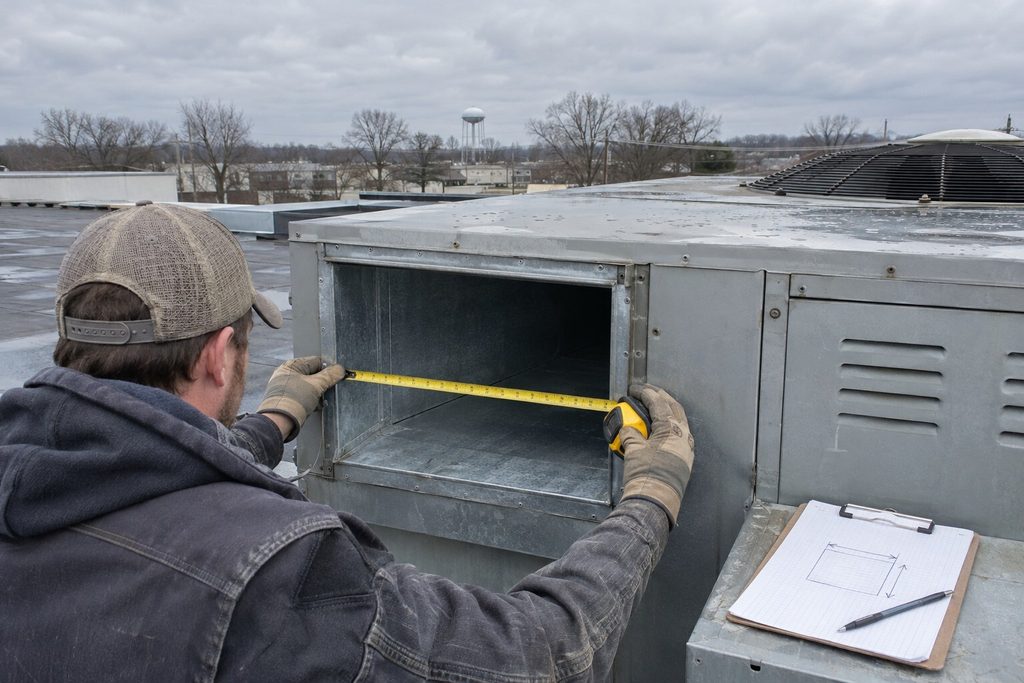
Retrofit jobs rarely come with drawings. For a curb adapter, a transition to existing duct, or a replacement guard, field measurements replace the drawing. Take them carefully and photograph them.
- Measure the existing opening and the new equipment opening, and note the model numbers.
- Photograph each measurement with the tape in the frame.
- Note obstructions such as pipes, conduit, beams or roof slope that the part has to clear.
- Mark which side is up and which way the air flows.
Measurements of the real equipment are better than nameplate or catalog data on retrofit work.
If you’re sending a rooftop job, our roof curb guide has a full measurement list.
How We Turn Your Request Into a Sheet Metal Fabrication Quote
Once your details arrive, we review the job and ask any questions about specs or fit. Then we send your quote and a build timeline. That’s the same three-step process listed on our site, and a complete package lets us move through it without stopping.
We cut parts on our plasma table, bend and form them on our press brake, and weld in the shop at 1588 Clara Street in Columbus. Because the cutting, forming and welding happen under one roof, we can price the whole part from your package instead of waiting on outside vendors. Our shop holds R-Stamp certification, an authorization the National Board of Boiler and Pressure Vessel Inspectors issues for repair and alteration of pressure-retaining items. We also weld on site when a field fix is needed.
A complete request is the fastest path to a sheet metal fabrication quote you can put in your own bid.
Frequently Asked Questions
How do I get a quote or start a project with you?
Call us at (614) 989-6835 or fill out the contact form on our website with details about what you need. We’ll ask about your project requirements so we understand the scope before we quote. For custom or time-sensitive jobs, share as much detail as you can up front, including dimensions, materials and your timeline. Whether it’s a single custom part or a larger commercial fabrication job, reach out and we’ll get the process started.
Is your pricing reasonable for custom sheet metal work?
We aim to keep our pricing reasonable while delivering quality custom work. Every project is different, so the cost depends on materials, size and the complexity of the work. We quote after we understand your project rather than charging a flat rate for everything. If budget is a concern, tell us up front and we can talk through options that fit your project.
Do I need a CAD drawing to get a sheet metal fabrication quote?
No. A hand sketch with clear dimensions, material, quantity and your deadline is enough to start on many parts. CAD files or PDF drawings help on complex parts and larger runs.
Can you quote a single custom part?
Yes. We build one-off parts. Send your drawing or measurements, and we’ll quote the part the same way we’d quote a larger run.
What should I send for a retrofit job with no drawings?
Send field measurements of both openings, photos with the tape measure in the frame, equipment model numbers, and notes on anything the part has to clear.
Send Us Your Drawings for a Fast Quote
A complete package saves your crew rounds of back-and-forth and protects your install date. We cut, form and weld every part in our own Columbus shop for contractors across central Ohio, from single custom pieces to full packages built to your drawings.
Call (614) 989-6835 or request a quote and send us your drawings.